





How Long Does a Compensation Claim Take in Australia
Most compensation claims in Australia settle within 9 to 18 months. But some can take longer, depending on the type of claim, the complexity of your case, and whether the claim ends up in court.
If you’ve already lodged a claim, you’ve probably noticed how slow things can feel. Medical reports can take weeks, insurers may respond slowly, and the legal process often moves at its own pace. At vbr Lawyers, we handle personal injury claims across Queensland, so we see these delays happen regularly.
And the frustration is understandable. You’re likely dealing with lost wages, medical expenses, and maybe ongoing treatment as well. All of that adds pressure while you wait for the claims process to move forward.
In this article, we’ll walk through the full compensation claim timeline. We’ll also look at what affects how long your claim takes, how different claim types compare, and what stages you can expect along the way.
First, we’ll explain the stages involved in making a personal injury claim.
A Simple Guide to the Personal Injury Compensation Process
The compensation claim process usually moves through three main stages: lodgement, evidence gathering, and resolution. Each stage takes time, and delays at any point can extend your overall timeline.
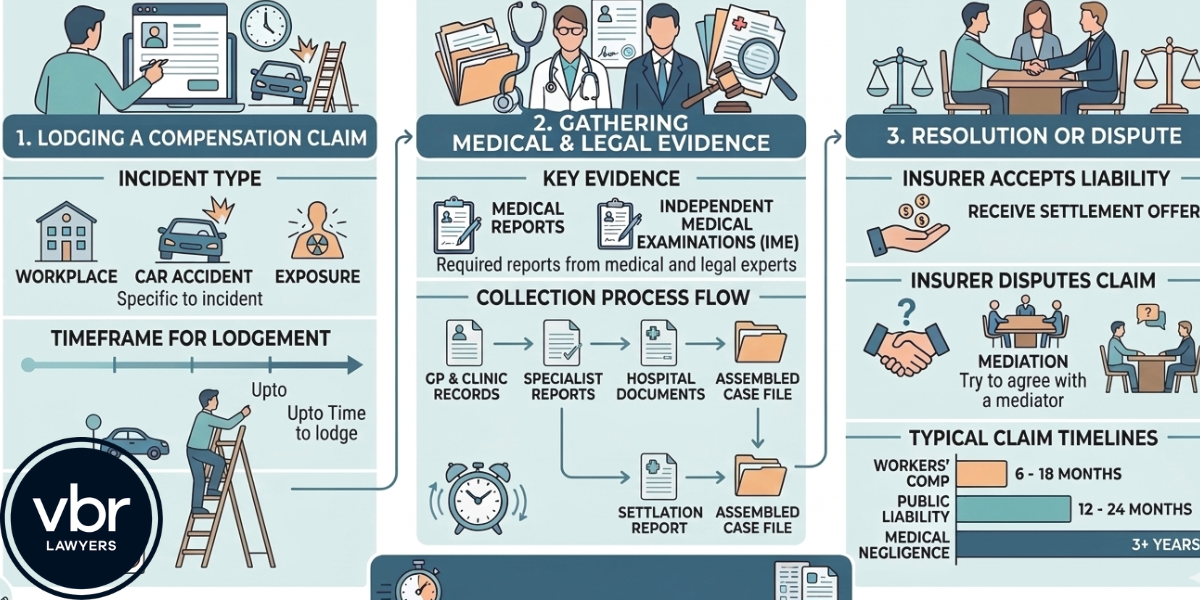
Let’s break down what happens at each stage so you know what to expect.
Lodging a Compensation Claim
Every claim begins with an incident. That could be a workplace injury, a car accident, or exposure to something harmful like asbestos or silica dust. Once the incident occurs, you need to lodge your claim within a specific timeframe set by law.
For workers’ compensation claims in Queensland, you should report the injury to your employer as soon as possible. In most cases, you have up to six months from the date of injury to lodge a workers’ compensation claim. Public liability and motor vehicle accident claims, on the other hand, allow more time, usually up to three years from the date of injury to lodge a claim.
After you lodge, the insurer generally has about 20 business days to decide whether to accept the claim or investigate it further.
Gathering Medical and Legal Evidence
Once your claim is lodged, the next stage involves collecting evidence to support your case. This is where things can start to slow down (depending on how complex your injuries are).
You’ll need medical reports from your GP and possibly from specialists as well. These reports should outline the extent of your injuries, your treatment so far, and your expected recovery. In many cases, the insurer will also request an Independent Medical Examination. Here, a doctor they choose will assess your condition to confirm the extent of your injuries.
Getting records from multiple healthcare providers takes time, as each clinic or hospital must prepare and release its own documents.
So if your treatment took place at several locations, collecting everything can add a few extra weeks. The process may slow down even more if paperwork is missing or if doctors provide different medical opinions. To keep things moving, contact each clinic or hospital regularly to check the status of your records and confirm they have sent the required documents.
Resolution or Dispute
After all the evidence is in, your claim will move toward resolution. What happens next will depend on whether the insurer accepts liability or decides to challenge your claim.
If they accept, you may receive a settlement offer. This is a lump sum payment to cover your medical expenses, lost wages, and other losses. You can accept this offer, or you can negotiate for a higher amount if you believe it doesn’t reflect the full impact of your injury.
On the other hand, if the insurer disputes your claim, the case could move to mediation or even court. Mediation is a meeting where both sides try to agree with the help of a neutral third party. Court is typically the final option if mediation fails. This can add several months or even over a year to the process.
However, how long your claim takes overall will depend on its type. For example, workers’ compensation claims usually resolve in 6 to 18 months. Public liability claims often take longer, which is around 12 to 24 months. Medical negligence claims are more complex and can last over three years, especially if the injuries are severe or expert opinions are disputed.
Why Some Claims Take More Time to Resolve
Some compensation claims take longer because of factors you can’t always control. Medical complexity, evidence disputes, and administrative backlogs can all add months to your timeline.

Below, we’ll share what causes these delays to help you prepare and avoid surprises along the way.
Complex Medical Situations
Your medical condition strongly affects how long your claim takes. If you recover slowly or unpredictably, it can take time to understand how your injuries affect you and what long-term problems may remain. This means your legal team and the insurer will have to wait for an up-to-date understanding of your condition before they can agree on a fair settlement.
In more serious cases, you may need to see several specialists. Since each one provides their own report, consolidating those reports will take time.
If you’re still receiving treatment, your lawyer may suggest waiting until you reach what’s called maximum medical improvement. This is the point where your condition has stabilised and further recovery is unlikely.
Settling before you reach this point can be risky since you may not account for future medical costs, ongoing treatment, or lost wages. It’s better to wait a bit longer for a more accurate picture of the full value of your claim.
Evidence Gaps or Disputes
Another common reason for delays is missing or inconsistent evidence. Your insurers will need complete information before they can move forward. So if there are gaps in your medical records or if two reports say different things, the insurer will request specific follow-ups.
These can include extra medical tests, corrected reports, or detailed treatment invoices, to make sure they fully understand your case. Sometimes, they’ll order another Independent Medical Examination to get a second opinion. This adds more time, but it’s a normal part of the process for many injury claims.
Now, things get more complicated when multiple parties are involved. For instance, a car accident may include two drivers (each with their own insurance company). Similarly, a workplace injury might involve both your employer’s insurer and a third party. Because each party may see responsibility differently, negotiations can take months to resolve.
Legal System and Administrative Delays
The legal system itself can also slow things down. Courts and mediation services often have packed schedules, so getting a hearing date might take several months. In Queensland, personal injury claims also follow specific procedures under compensation law, and each step can take anywhere from a few weeks to several months to complete.
Insurers sometimes also request extensions to review evidence or prepare their response. Procedural backlogs happen, too, especially during busy periods. This is when courts or agencies have too many cases to handle quickly. And if your claim involves laws from different states, the differing rules between jurisdictions can add another layer of complexity.
These delays are stressful, but they don’t always mean something has gone wrong. Sometimes, they’re just part of how the system works. Make sure to stay in regular contact with your compensation lawyers to understand where things stand and what’s coming next.
Set Realistic Expectations for Your Compensation Claim
Hopefully, this article has helped clear up some of the confusion around how long these compensation claims actually take.
Always remember that every claim is different. So a straightforward workers’ compensation claim might settle within a year. However, a medical negligence claim with complex injuries could take three years or more. The timeline depends on your medical situation, the evidence involved, and how smoothly the legal process runs.
Waiting is one of the hardest parts of this process. You’ll be dealing with medical appointments, paperwork, and uncertainty about when it will all be over. That frustration is completely normal, and most people going through a claim feel the same way.
Keeping a record is one practical way to manage your claim. You can use a calendar or notebook to track important dates, documents you’ve sent, and any updates you receive. While this won’t speed up the process, it can help you feel more in control and organised.
If you want to learn more about how compensation claims work in Queensland, VBR Lawyers is a Brisbane-based compensation law firm.