




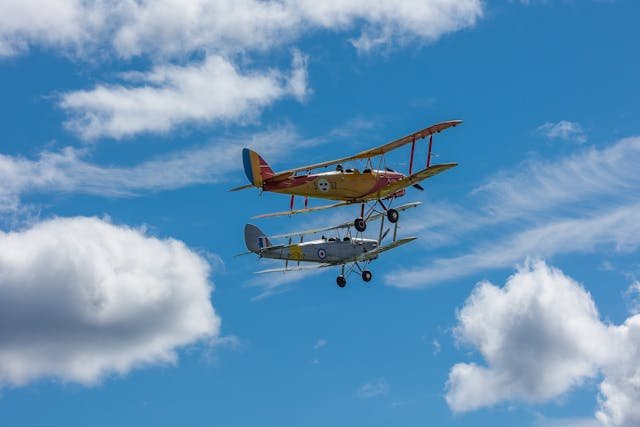
Tech and Aviation: How Does a Plane Fly?
The marvel of human flight has captivated our imaginations for centuries, transforming from what seemed impossible into something millions experience without a second thought. Modern aviation stands as one of humanity’s greatest technological achievements, think about it: we’re lifting machines weighing hundreds of thousands of pounds into the sky and keeping them there. Understanding how planes fly means diving into aerodynamics, exploring the intricate systems working together, and appreciating the engineering excellence that makes safe air travel possible. From the Wright Brothers’ first powered flight to today’s sophisticated commercial jets, the science of flight keeps evolving while staying grounded in those unchanging physical laws governing our atmosphere.
The Fundamental Physics of Lift
Lift is the primary force that gets aircraft off the ground, generated through the fascinating interaction between wings and surrounding air. Here’s where Bernoulli’s principle comes in: when air flows over the curved upper surface of a wing, it travels faster than the air moving beneath the flatter lower surface. This speed difference creates a pressure differential that pushes the wing upward, pretty elegant, right? That’s why wings have their distinctive airfoil shape, carefully engineered to maximize lift while keeping drag to a minimum. Newton’s third law plays its part too, as the wing deflects air downward, creating an equal and opposite reaction that pushes the aircraft up.
The Four Forces of Flight in Balance
Every aircraft in flight juggles four fundamental forces that must be carefully balanced for controlled, stable flight. Lift works against weight, that downward force created by gravity pulling on the aircraft’s mass, and you need sufficient lift to overcome that gravitational pull. Thrust, produced by engines (whether jet, turboprop, or piston-driven), propels the aircraft forward and must overcome drag, the resistance created as the plane pushes through the atmosphere. Drag comes in multiple flavors: parasitic drag from the aircraft’s shape pushing through air molecules, and induced drag created as a byproduct of generating lift.
Wing Design and Aerodynamic Innovation
Modern wing design represents decades of aerodynamic research and computational modeling to optimize performance across various flight conditions. Engineers juggle numerous factors, including aspect ratio (comparing wingspan to chord length), since longer, narrower wings generally produce more efficient lift with less induced drag. Those distinctive upturned wing tips you see on most commercial aircraft? They’re winglets, and they reduce vortex formation at wing tips, improving fuel efficiency by several percentage points over long flights, which adds up to significant savings. Flaps and slats are movable surfaces extending from the wing during takeoff and landing, temporarily changing the wing’s shape to generate more lift at slower speeds when it’s needed most.
Propulsion Systems and Engine Technology
Aircraft engines convert fuel energy into thrust through various mechanisms depending on engine type and aircraft requirements. Jet engines work by drawing in massive quantities of air, compressing it, mixing it with fuel for combustion, and expelling the resulting hot gases at high velocity to generate thrust. Turbofan engines, the most common type on commercial aircraft, bypass most incoming air around the engine core, making them more efficient and quieter than older turbojet designs. Piston engines driving propellers remain popular for smaller aircraft, converting rotational motion into thrust by accelerating air backward through the propeller disk.
Critical Systems and Hydraulic Technology
Beyond the visible components, aircraft rely on numerous interconnected systems that enable safe, controlled flight in diverse conditions. Hydraulic systems power essential flight control surfaces, landing gear operation, and braking systems, transmitting force through pressurized fluid to provide the mechanical advantage needed to move large control surfaces against significant aerodynamic forces. These hydraulic networks include pumps, reservoirs, valves, and complex assemblies distributing fluid throughout the aircraft while maintaining pressure and preventing leaks under extreme temperature variations and vibration. When servicing hydraulic systems, aviation maintenance professionals rely on aircraft hose assemblies to ensure reliable fluid transfer under the demanding conditions of flight operations. Redundancy gets built into every critical system, commercial aircraft feature multiple independent hydraulic systems so that failure of one doesn’t compromise flight safety. Electrical systems power avionics, lighting, passenger amenities, and backup flight controls on modern fly-by-wire aircraft where computers interpret pilot inputs and optimize control surface movements. Environmental control systems maintain comfortable cabin pressure and temperature, essentially creating a livable environment at altitudes where unprotected humans can’t survive. The integration and reliability of these supporting systems determine whether an aircraft design succeeds commercially and maintains the safety record that makes modern aviation remarkably secure.
Navigation and Control in Modern Aviation
Contemporary aircraft employ sophisticated navigation and flight control systems that would’ve seemed like science fiction to early aviation pioneers. Inertial reference systems, GPS receivers, and ground-based navigation aids work together to provide precise position information anywhere on Earth, enabling aircraft to follow optimized routes and land in poor visibility conditions. Fly-by-wire technology has replaced mechanical linkages with electronic signals, allowing computers to interpret pilot commands and adjust control surfaces in ways that optimize performance while preventing pilots from inadvertently commanding dangerous maneuvers. Autopilot systems can manage entire flights from shortly after takeoff through landing, though pilots remain essential for monitoring, decision-making, and handling abnormal situations that computers can’t anticipate.
Conclusion
The question of how planes fly encompasses far more than simple aerodynamic principles, extending into materials science, propulsion technology, systems integration, and human factors engineering. From the elegant physics of lift generation to the complex hydraulic and electrical systems enabling control, every aspect of flight represents careful engineering and continuous refinement throughout aviation’s history. Modern aircraft embody thousands of innovations, each contributing to the remarkable safety and efficiency characterizing contemporary air travel. As technology advances, aircraft are becoming more environmentally sustainable, with improved fuel efficiency, reduced noise, and ongoing research into alternative propulsion methods promising even greater improvements.